About The 1959 Project
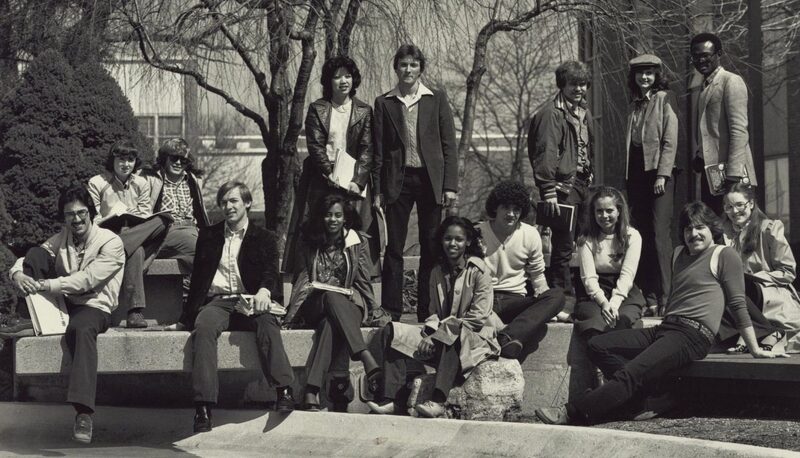
Philip T. Datillo, Students outside posed at pool's edge, University of Michigan Library Digital Collections, © Regents of the University of Michigan. This work is licensed under CC BY 4.0.
The 1959 Project originated as a mixed-methodology initiative aimed at recalling, sharing, and rethinking the evolution of the University of Michigan-Dearborn, from a specialized co-op education program to an autonomous regional campus.
Utilizing oral histories, surveys, focus groups, and research in the campus archives, The 1959 Project seeks to draft a more inclusive history that recognizes the contributions of students, faculty, and staff to the campus’ legacy. Their accomplishments sometimes were the result of efforts to uplift and sometimes achieved without the full support of the rest of the campus community or despite the chronic underinvestment in the Dearborn campus.
The project currently encompasses four digital humanities initiatives, which serve as both an expanding archive for inquiry and as avenues for restorative and reparative storytelling. These efforts are designed to inform the development of future reparative policies on the campus.
The 1959 Project team expects the infrastructure for digital oral history curation that is being developed for these collections will also serve as a useful repository for interviews generated by other IHP-funded projects on the Dearborn campus (including the “Institutional Memory Project,” which will examine the history of the Women and Gender Studies Program on our campus).
The 1959 Project currently encompasses four digital humanities projects:
Restored Voices
The Restored Voices collection will make digitally curated interviews from the archives of the university at the Mardigian Library available on a public database powered by the Oral History Metadata Synchronizer (OHMS) and OMEKA S. Both tools are used for other oral history databases at UM-Dearborn. Researchers are working on the curation of archived interviews with former faculty and administrators, including Wiliam E. Stirton, the Vice Chancellor who was the first Director of the Dearborn Campus from 1959-1968, Dr. Helen M. Graves, a professor of political science who helped found UM-Dearborn’s Commission for Women in 1974, and former Chancellor Blenda J. Wilson, who became both the first African American and first woman to lead any University of Michigan campus – indeed the first woman to lead any public university in Michigan – from 1989-1992.
Shared Campus Lives
The Shared Campus Lives collection will feature newly recorded interviews of individuals with memories of the earliest years of the campus and key inflection points in its history. Having established both an initial list of interviewees and a process for identifying more among UM-Dearborn alumni and former faculty and staff, researchers began scheduling interview sessions in August 2024.
Michigan Middle East Traveler’s Oral History Project (MMETOHP) Phase 2
The Michigan Middle East Traveler’s Oral History Project (MMETOHP) will focus its next round of interviews on members of the campus community who have traveled to the Middle East. In addition to the Phase 1 focus on how individuals navigate “regimes of im/mobility,” researchers will explore how connected individuals feel to the campus community and the Dearborn campus itself. Researchers are currently developing a survey of staff, students, faculty, alumni and retirees to identify potential interviewees. This two-part approach enables individual stories to add nuance to the information gathered from the anonymized data of the surveys.